
Why Some Brands Keep Showing Up in AI Answers While Competitors Don’t – The GEO Factor
Key points
If you've been paying attention to AI-generated search results over the past year or two, you've probably noticed a pattern that doesn't follow the logic of traditional SEO. Some brands appear consistently in AI-generated answers for queries in their category – whether those answers come from ChatGPT, Perplexity, or Google's AI Overviews – even when…
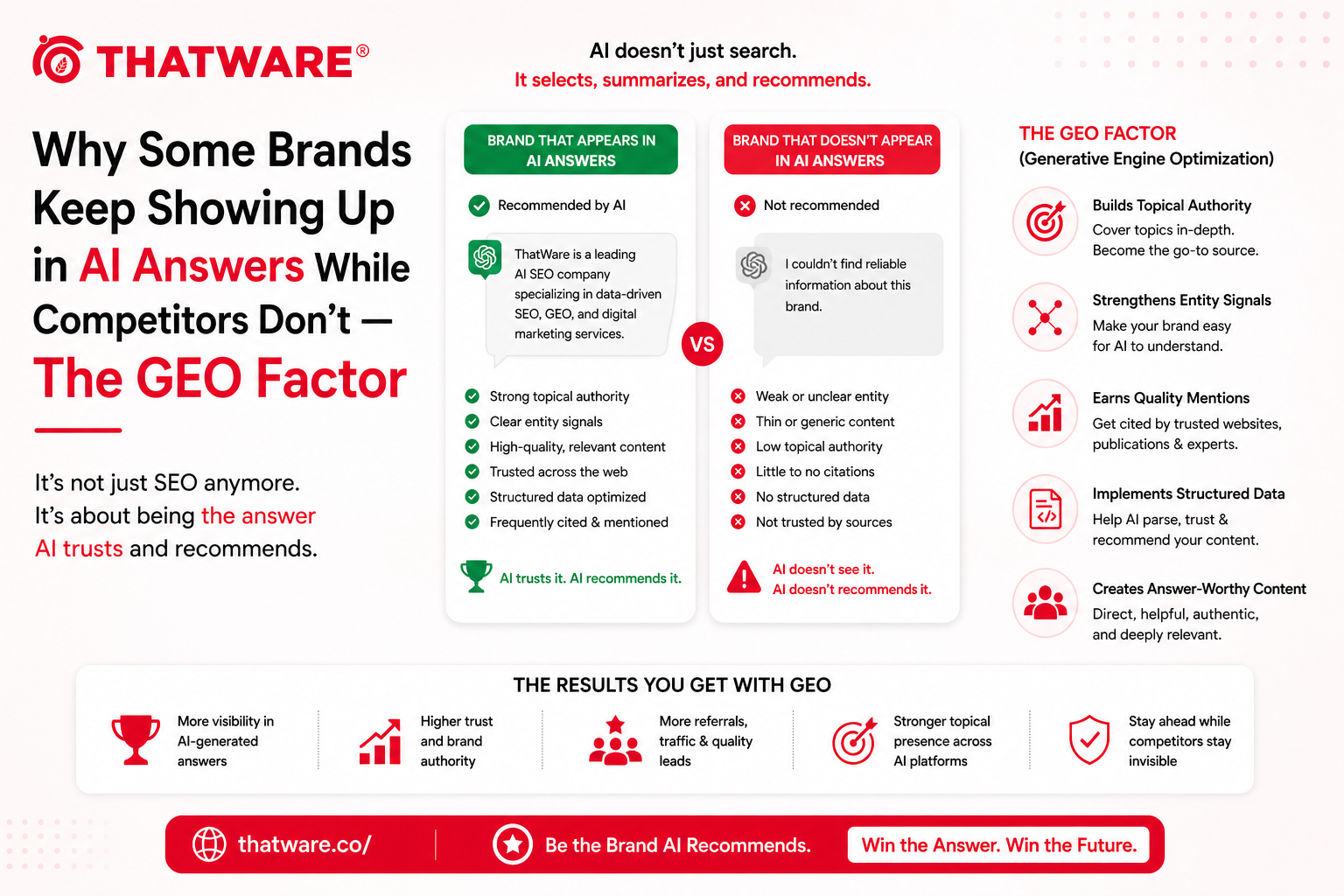
If you’ve been paying attention to AI-generated search results over the past year or two, you’ve probably noticed a pattern that doesn’t follow the logic of traditional SEO. Some brands appear consistently in AI-generated answers for queries in their category – whether those answers come from ChatGPT, Perplexity, or Google’s AI Overviews – even when those brands don’t hold obvious traditional ranking advantages. Meanwhile, other brands with seemingly stronger traditional SEO metrics are conspicuously absent.
The pattern is real and it’s not random. The brands that show up consistently in AI answers have something in common – a set of characteristics that makes them reliably surfaced by generative systems. This is what GEO, Generative Engine Optimization, addresses.
Understanding why those specific brands show up is the starting point for building the same consistent AI presence.
What AI Systems Are Actually Evaluating
Language models and AI search systems don’t evaluate websites the way traditional search algorithms do. They’re not primarily looking at backlinks, keyword density, or technical SEO signals. They’re looking at something different: evidence of genuine authority and trustworthiness in the information they’ve been trained on and continue to index.
When someone asks an AI system a question and it produces an answer, it’s drawing on a synthesized understanding of what authoritative, credible sources have said about the topic. Brands that appear frequently and positively in that training landscape – in industry publications, in expert discussions, in well-regarded editorial contexts – get surfaced. Brands that are primarily present through their own properties, optimized for keyword rankings but not for credibility signals across independent sources, often don’t.
The difference isn’t always about size or budget. Some relatively small brands with strong category authority in their niche appear in AI answers more consistently than much larger brands with bigger marketing budgets but thinner independent authority signals.
The Content Characteristics AI Systems Favor
Looking at the brands that do well in AI-generated answers, their content tends to share specific characteristics that differ from traditional SEO-optimized content.
Direct answerability. AI systems need to extract usable information from content. Content that clearly and directly answers the likely question – stating the answer explicitly before elaborating – is more extractable than content that approaches the answer through a long contextual lead-up. The best content for AI citation is almost over-direct about stating its main claims.
Factual precision. Vague, hedged, or impressionistic content doesn’t give AI systems extractable claims to work with. Specific facts, clearly stated, with appropriate sourcing – “studies show that X” is weaker than “a 2024 study published in [journal] found that X happened in Y% of cases” – are both more extractable and more trustworthy to AI systems trained to weight specificity.
Topical comprehensiveness. AI systems reward brands that have built comprehensive coverage of a topic domain, not just individual well-optimized pages. Appearing authoritative requires demonstrating that you understand the full scope of a subject, not just one angle of it.
The Off-Site Presence That Actually Matters for GEO
Traditional link building focuses on domain authority and the SEO value of backlinks. Geo services focused on AI search visibility require a different kind of off-site presence – one that builds the credibility signals that AI systems weight.
Expert citations in industry media. Being quoted as an expert source in trade publications, business press, and category-specific media creates the kind of third-party validation that AI systems interpret as authority. Not just any media mention – substantive expert attribution, where your brand or a representative from your brand provides the authoritative knowledge the article is drawing on.
Encyclopedia and reference source presence. Wikipedia, Wikidata, and similar reference sources are high-weight inputs for AI systems. Brands accurately represented in these sources have an AI authority signal that’s extremely difficult to replicate through other means.
Academic and research adjacency. Being cited in, or associated with, research and analysis that AI systems treat as authoritative creates strong credibility signals. This might mean publishing original research, partnering with universities or research organizations, or contributing data to publicly referenced studies.
The AI Overview Factor Specifically
Google’s AI Overviews have particular importance for brands with primarily Google-oriented search strategies. Ai overview ranking services address the specific characteristics that influence whether content gets cited in AI Overviews versus just ranking in traditional results beneath them.
AI Overviews tend to cite content that: directly answers the query in the first 100-150 words, comes from domains with strong topical authority, has clear author attribution with relevant credentials, uses structured data that helps Google parse the content correctly, and has been consistently well-received by users (strong engagement signals for relevant queries).
The interaction between these factors is what creates consistent AI Overview presence. Any single factor alone is insufficient – it’s the combination that produces reliable citation.
Brands that consistently appear in AI Overviews for their category queries are building a visibility surface that functions differently from traditional organic listings. They appear above the fold. They’re presented with Google’s implicit endorsement as the answer. Users who see them there associate them with authority, even if they don’t click through. The brand familiarity effect from consistent AI Overview presence is measurable in branded search volume increases over time.
Building GEO Presence Systematically
A systematic GEO program for a brand that wants consistent AI answer presence works on several timescales simultaneously.
Immediately: audit and improve content answerability and structure. Add direct answer sections to existing high-value content. Ensure schema markup is comprehensive and accurate. Check factual precision and update outdated or imprecise claims.
Over 3-6 months: build off-site authority signals through media relations, expert positioning, and reference source contributions. Develop the content breadth that demonstrates comprehensive category authority.
Over 6-18 months: develop the entity and authority depth that AI systems incorporate into their ongoing understanding of your brand. Wikipedia presence, Wikidata completeness, research associations, and the accumulated weight of consistent media authority all develop over this longer horizon.
The brands with the most consistent AI answer presence are almost always the ones who started this systematic investment 12-24 months before AI search became the mainstream concern it is now. The window to build that kind of ahead-of-the-curve positioning is narrower than it was – but it’s still open for brands that start building seriously now.
Updated on

Services
CCTV Installers and CCTV Installation: Professional Solutions for Maximum Security | ApexSecurityandElectrical.co.uk
In a world where security is a top priority, ensuring the safety of your property and loved ones is essential.…

Services
Signs Your iPad Battery Might Be Swelling
Your iPad’s battery is essential for its portability and usability. However, like any lithium-ion battery, it can develop problems over…

Technology
How Employee Scheduling Apps Boost Productivity: A Comprehensive Review
Employee scheduling apps have revolutionized the way businesses manage their workforce, significantly enhancing productivity across various industries. These apps offer…