
Allied Connectors: What Engineers and Procurement Teams Need to Know About India’s Established Circular Connector Manufacturer
Key points
When engineers and procurement officers in India search for qualified circular connectors for defence, railway or industrial applications, the name Allied Connectors appears with some regularity. The brand represents the product range of Allied Electronics Corporation, a Mumbai-based manufacturer established in 1966, and it covers a wide family of mil-grade and industrial circular connectors built…
When engineers and procurement officers in India search for qualified circular connectors for defence, railway or industrial applications, the name Allied Connectors appears with some regularity. The brand represents the product range of Allied Electronics Corporation, a Mumbai-based manufacturer established in 1966, and it covers a wide family of mil-grade and industrial circular connectors built to both MIL and VG specifications. Understanding what the brand actually offers, how it is qualified and what distinguishes domestic manufacture from import alternatives is useful context for anyone specifying or procuring in this category.
A Manufacturer, Not a Trader
The Indian connector market includes a large number of trading companies that import connectors and resell them under various names, alongside a smaller number of manufacturers that actually design, machine and assemble connectors in India. The distinction matters because a manufacturer can provide qualification evidence against Indian and international standards, can customise insert arrangements and shell configurations, can supply spare contacts and accessories, and can provide application engineering support from engineers who understand the product from the inside. Allied Electronics Corporation falls in the manufacturing category, with machining, plating, assembly and testing conducted at its Mumbai facility.
The Product Range
MIL-Specification Families
The core of the Allied Connectors range covers circular connectors built to MIL-DTL-5015 and related MIL specifications, available in both MS and MG variants. The Allied Connectors range under MG designation covers the VG 95234 reverse bayonet family, which is essential for railway rolling stock and European-origin defence equipment. The MS designation covers the threaded coupling family aligned with MIL-DTL-5015, which remains the dominant standard for US-specification defence and aerospace programmes. Both families share common contact technologies and accessories, which simplifies mixed-fleet maintenance.
Shell Sizes, Insert Arrangements and Service Classes
The range spans shell sizes from size 10 to size 36 and offers dozens of standard insert arrangements mixing contact sizes for power, signal and hybrid applications. Service classes differentiate connectors by their environmental sealing and contact construction, allowing engineers to select the appropriate level of protection for each application rather than over-specifying throughout. The connectors are available with olive-drab cadmium plating for legacy compatibility and with modern RoHS-compliant alternative finishes that satisfy current environmental regulations without compromising corrosion resistance.
Qualifications and Approvals
Qualification approvals are the currency of the defence and railway connector market, and they take years to earn. Allied Electronics Corporation holds approvals from the Ministry of Defence for its mil-grade connector ranges and is listed as a qualified supplier with RDSO for railway applications. Several major defence public sector undertakings and private defence system integrators include Allied Connectors on their approved vendor lists. For procurement officers, this means that the documentation burden associated with sourcing from a new supplier is substantially reduced compared with an imported product that has not undergone Indian qualification.
Cable Harness Assemblies and Value-Added Services
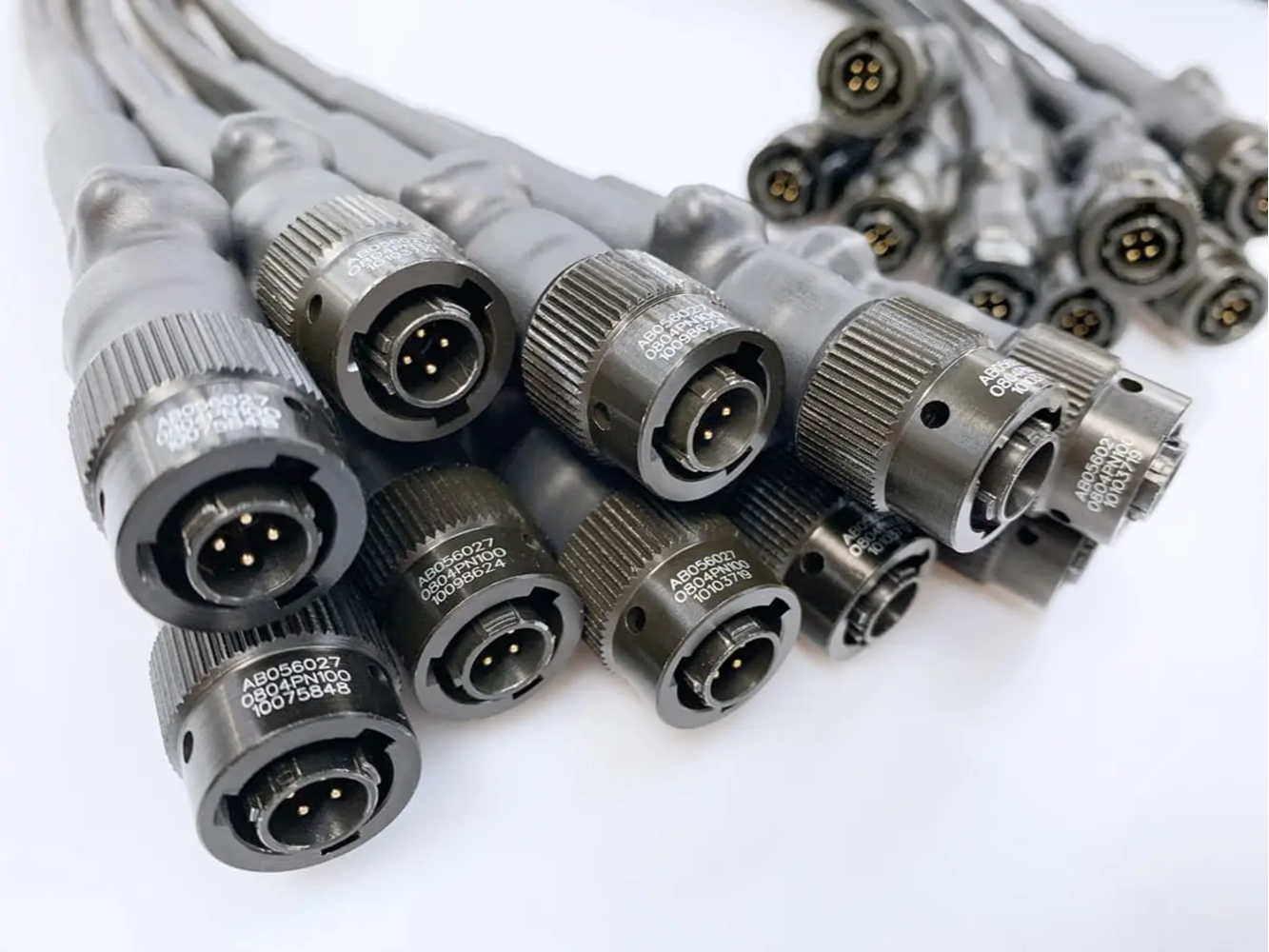
Beyond loose connectors and accessories, Allied Electronics Corporation manufactures cable harness assemblies incorporating its own connector ranges. For OEMs and system integrators, procuring a tested harness subassembly from the connector manufacturer eliminates the compatibility uncertainties that arise when connectors, contacts and cables are sourced separately. The company’s harness manufacturing capability covers defence vehicle wiring, locomotive control looms and industrial machine harnesses, with one hundred percent electrical testing before despatch. This integrated offering — from raw connector through finished, tested assembly — is unusual in the domestic market and represents a practical advantage for programme managers who want to reduce supplier count and simplify traceability.
Why Domestic Manufacture Matters in the Current Environment
India’s defence and railway modernisation programmes operate under strong policy pressure to increase domestic content. The Make in India, Atmanirbhar Bharat and IDEX programmes create both incentives for domestic sourcing and, in some cases, mandatory domestic content requirements for qualifying contracts. For connectors, this means that a domestically qualified manufacturer is not merely a convenient alternative to imports but is often a programme requirement.
Beyond policy, practical supply chain arguments favour domestic sourcing. Lead times measured in weeks rather than months, rupee-denominated pricing that eliminates currency risk, direct access to application engineers in Indian Standard Time, and the ability to inspect the manufacturing facility are all advantages that do not appear in a datasheet comparison but matter considerably when a programme is under time pressure.
Specifying Allied Connectors Correctly
Like any mil-grade circular connector family, Allied Connectors products require correct specification of shell size, insert arrangement, service class, coupling type and accessory selection. The company’s technical team provides specification support and can review customer circuit lists to recommend appropriate insert arrangements. For non-standard requirements, the customisation capability allows insert arrangements and shell configurations not found in the standard catalogue. Engineers specifying these connectors for the first time should request the technical catalogue and, where possible, discuss the application directly with the manufacturer’s engineering team before freezing the design.
Established circular connector manufacturers in India like Allied Electronics Corporation represent an important capability for any programme requiring qualified interconnects with domestic supply chain benefits, and the breadth of the Allied Connectors range means that most standard circular connector requirements can be met from a single source.
Conclusion
Allied Connectors covers a wide range of mil-grade and industrial circular connectors manufactured domestically to MIL and VG specifications, backed by qualification approvals from Indian defence and railway bodies. For engineers and procurement teams working on defence systems, rolling stock, power equipment or industrial automation, the combination of qualified products, domestic manufacturing and integrated harness capability makes Allied Electronics Corporation a logical supplier to evaluate. Requesting the technical catalogue and an application engineering conversation is the right starting point for any new design or procurement activity.
Updated on

Business
How to Choose the Best Liver Supplements in Australia Based on Ingredients, Not Marketing
The liver is one of the hardest-working organs in the body. It plays a role in hundreds of physiological processes,…

Business
Why Leadership Skills Matter More Than Ever in Today’s Business World
The modern business environment is more complex and unpredictable than ever before. Rapid technological change, global competition, and shifting consumer…

Business
From Manual Hustle to Systemized Workflows: The Evolution of Multi-Account Management
In the early days of online business, managing multiple accounts was often a sign of growth. More stores, more ad…